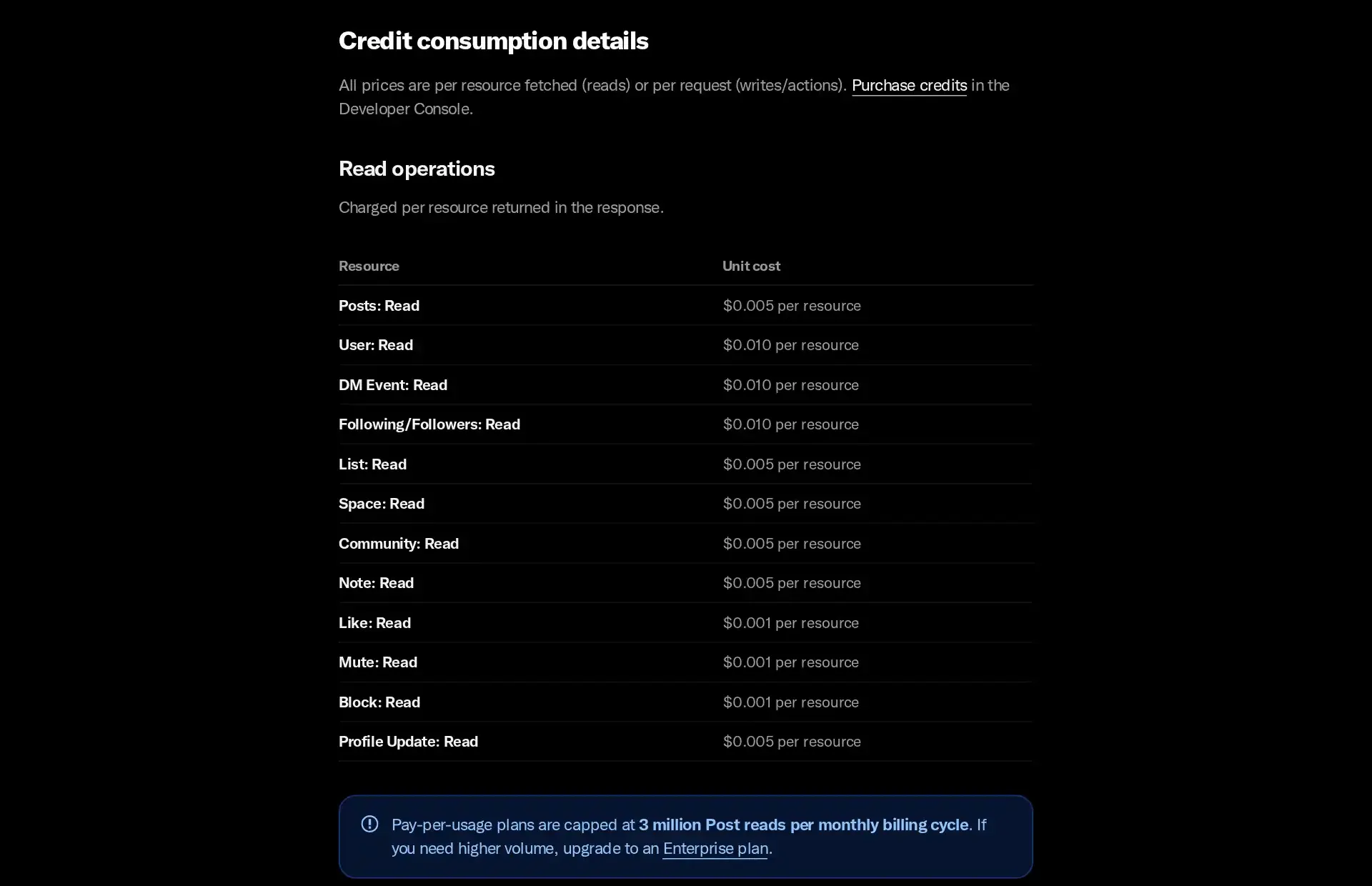
X bills its API per item at $0.005 a post and $0.010 a profile, putting 1,000 posts at $5.00 and 1,000 profiles at $10.00. LurkAPI charges $0.05 per 1,000 posts and $0.93 per 1,000 profiles, which works out to over 100 times cheaper per post and over 10 times cheaper per profile.
A page of about 20 tweets comes back in a median of 1.1 s. When you sign up, you get 100 credits with no card required, enough for around 2,000 tweets.
X API prices
| What X’s API returns | Price each | Per 1,000 |
|---|---|---|
| A post | $0.005 | $5.00 |
| A profile | $0.010 | $10.00 |
Comparing the X API and LurkAPI on 4 jobs
| Job | X API | LurkAPI | LurkAPI per 1,000 posts |
|---|---|---|---|
| Last 100 posts from 500 accounts (50,000 posts) | $250.00 | $2.79 | $0.06 |
| 10,000 profile lookups | $100.00 | $9.29 | $0.93 per 1,000 profiles |
| Latest 20 posts from 10,000 accounts (200,000 posts) | $1,000.00 | $9.29 | $0.05 |
| 3 million posts in a month | $15,000.00 | $88.50 | $0.03 |
What one call returns
| One call returns | Per 1,000 |
|---|---|
| Tweets and retweets for an account, returning about 20 per page along with text, media and engagement counts. | $0.05 to $0.03 per 1,000 posts |
| A full profile with bio, avatar, verification status and exact follower, following, tweet and like counts. | $0.93 to $0.59 per 1,000 profiles |
| A single tweet with text, author, likes, replies, reposts, quotes, bookmarks, views, playable MP4 media and any quoted tweet. | $0.93 to $0.59 per 1,000 tweets |
GET/v1/twitter/user-tweets
1 credit per requestRun it to see live data here.
Which one to pick
If you need to publish posts or send DMs from your own account, use X’s API at $0.015 per post and $0.010 per message. For pulling tweets, profiles and metrics from public accounts, LurkAPI runs $0.05 per 1,000 posts instead of $5.00.
If you are comparing tools, check out our guides on the best Twitter scrapers, what Apify scrapers cost and how to monitor a Twitter account.
Start free
You get 100 free credits as soon as you sign up with no card required, enough for about 2,000 tweets that X would bill at $10.00, and another 20 credits drop into your account every day. When you need more volume, the $39 Pro pack pulls around 840,000 posts, compared to $4,200 on X’s API.
Copy for AI
Pull the last 100 posts from each X account on my list, starting with @NASA. Give me a table with each account's follower count, posts per week, and average likes, replies and views per post, plus the total credits used.
Or connect LurkAPI to your app in one click: